The wars that nepali kingdoms had been involved in were called 'Gorkha wars'. Nepalese crossed Kumaon, Garhwal and reached hills of present day Himachal. East India Company sent their officer with his forces who succesfully evacuated the area of 'Gorkhali', but also appreciated their valour. After the Gorkha wars of 1814-1816, the Imeprial forces decided to keep a post in the area, which gradually developed into Shimla.
In colonial times it was called 'Simla'. The English might have developed it, but it was inhabited before their arrival. The area of Shimla sprawls over seven hills.
Jakhoo hill is the highest of them. It was probably inhabited by significant population in pre-colonial times. The Jakhu temple is considered to be ancient.The folklore says that Lord Hanuman stopped here seeing Sage Yaksha (Jakha-Jakhu) to learn about Sanjivni Booti. It is also said that there was a blue cottage of a fakir near the temple - shyamal kutir after which shimla came to be known. Others say that the name is after Goddess Shyamala devi or Kali, whose idol was also there on the Jakhu hill, but was later shifted to another hill,
Bantony hill, where it is present in the Kali Bari temple today. Another structure on the the top of Bantony hill is what was built as Bentick Castle in 1829 as residence of Governor General William Bentick. It later became premises for Dak Bungalow, Bank and Club. Finally it was purchased by a confectioner and changed into a hotel and then acquired by the Government. Today it houses the Grand hotel where we stayed. It's a great property, especially after its renovation in 2010 and is self sufficient for water due to rain harvesting. However it lacks services.
Grand Hotel directly leads to the Mall Road. Mall Road of Shimla epitomizes the spirit of Shimla and the spirit of every Mall Road. If one has to understand the meaning of the term Mall Road, one has to spend time on Mall Road of Shimla and one would spontaneously imbibe meaning of the term.
Just as one leaves the hotel is a dilapidated building good enough to be an old castle. In fact it is the old palace of Mahraja of Sirmur and is reportedly being restored. But some people say it was the bantony castle built by Lord bantony. This is the third important place on Bantony hill. However nobody spares it a look. Even the hawker sitting in front of this 'Palace' had his '
Chhabba' of Litchis confiscated by the Police.
 |
| Erstwhile Palace on Bantony Hill |
There is a huge and old but well built BSNL building on the right. And as one crosses the GPO on the left one reaches THE Mall Road!
The GPO is one of the oldest post offices in the country and is a heritage now. It started as Conny Cottage and may have housed Shimla bank and shops of European tailors initially.
Bantony hill is the central hill of Shimla. From the Grand Hotel it gradually leads to the Scandal point, which is the main 'chowk' of Mall Road. The lore is that Maharaja of Patiala eloped with the daughter of Vice-Roy from here and hence the name. As shimla was the capital of Punjab after independence, a statue of Lala Lajpat Rai, the Lion of Punjab was erected here. The Scandal point is also the highest point of Mall Road as it ascends from south-west and descends to south east.
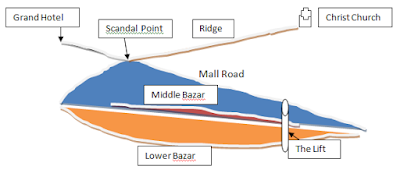 |
| A Line diagram of central hill of Shimla |
Towards the north-west from scandal point up goes the ridge or the highest elevation of the hill towards the Church. One can view the northern valley from here. A small '
pagdandi' kind of a trail descends northwards from the scandal point, on which is located 'The tibeti bazar'. It is the most steep and narrow path that I have seen any tibeti bazaar on.
Ascending on the ridge is a pleasant walk. On the right one gets the Ridge side of the Gaiety theater complex that houses some shows. 'Jadugar samrat Shankar's show was on, during our visit, we mused ourself on the 'water of india', that had kept us giggling in one of his past shows. Ridge was supposedly 'upper bazar' earlier but a fire cleared it and this area was used to build this complex.
 |
| The theater complex from the ridge side |
Further above one reaches the main square always full of hustle-bustle of visitors. Kids can be seen taking pony rides. The unique feature of Mall Road and Ridge area is that municipality has kept lot of seating arrangement and one can usually find a place to sit even in the peak tourist season. A tall pole with national flag on it now adorns the ridge!
The municipality has built a stage at a height with places to sit and view the shows. It is said that many popular open-air shows are held here during summer festival. On the back of the stage goes the trek towards the Jakhu hill. On the Right, lies the 'Christ Church', that serves as emblem of Shimla. If one moves further towards the left there is a slope on which is located 'Lakkad bazar'. This is another hill of Shimla known as Elysium hill.
 |
| View from the ridge |
 |
| View of Shimla in 1884 from Jakhu Hill. The church stands out! |
 |
| Scandal Point during Rain |
 |
| 'Tomorrow's Antique' That holds true for Lakkad Bazar even today! |
One has to keep coming back to Scandal Point in Shimla! There are interesting shops around on The Mall. One shop called Rama & Sons sells a vast variety of umbrellas. The proprietor claims he has ranges from 200 rs to 7000 rs. They have tent shaped umbrellas and chinese umbrellas in their range.If one starts walking downhill on the mall road from the scandal point towards the lift, one is taking 'The walk on the Mall'. As no vehicles are allowed here, roads are all to the pedestrians without a need to reclaim them. One crosses fire station and then there is the gaiety theater complex on the left that houses the police station.
It is said that, on the lines of Royal Albert Hall, London, five gaiety theaters were built around the world and this is one of them. This complex has an old theater, that gives the original Edwardian era feel. It is said that lot of plays, where even vice-roys enacted were played here. Post independence theater artistes including prithvi Raj kapoor have performed here. Three hindi movies, Kudrat, badalte rishte and Gadar have been shot here.Besides the theaters it has hall that houses exhibitions! Immediately after the theater is a flight of stairs that descends from Mall Road to the middle bazar, this houses some of the famous traditional food shops.One has to walk down further to reach combermere hotel, Lift and the Wax Museum. Though shops close around nine, food shops remain open till 11 pm.
Descending down on the other limb of Mall Road from Scandal point, one comes across Indian Coffee House and Himachal Emporium, that ends at CTO.
After the revolt of 1857, Queen Victoria decided that company was not able to handle the affairs, and took control of India directly under British Government. This is when instead of Governor-General, India was to be ruled by a Vice Roy. Highest seat of government needs to be at the highest. This is when a Vice-regal house was planned at the top of Observatory hill as Shimla was the summer capital of the country. Earlier Murree in rawalpindi was the summer capital but Shimla was more convenient though still far from Calcutta, the main capital. Vice regal lodge was built during the time of Lord Dufferin. While the exterior was built with the locally available stone, wood for interior was teak from Burma and Ceiling was designed with Walnut wood from Kashmir with traditional kashmiri craft. All the furniture was brought from England. This building has marvellous fire-fighting system installed and a fire station has been built within the campus. This building was designed with provision of electricity though there was no electricity in India at that time. All the lawns have underground rain harvesting tanks.
The kashmiri ceiling design is known as 'khatambandh'.
 |
| Khatambandh-seen on the ceiling of Vice-regal lodge. |
"Brought to Kashmir in 1541 by Mirza Hyder Douglat, Khatamband is an art of making ceiling, by fitting small pieces of wood (preferably walnut or deodar wood) into each other in geometrical patterns. All this is done entirely with hands without use of nails. The wood is processed, cut into buttons and panels and fixed in the ceiling in various floral and geometrical designs.Indeed a painstaking work, which once used to take months to finish a 10 feet by 10 feet ceiling. The uniqueness of this art is that when the ceiling is complete, it acquires a unique geometrical pattern. With fewer or no nails used at all, the Khatamband ceiling can easily be dissembled and re-assembled at another place."


