Wednesday, June 29, 2016

Shimla: The erstwhile summer capital on seven hills.

A man without ambition is a dead man! But is it always good to have himalyan ambitions? History testifies that even those who have abode in Himalayas have other aspirations. Man of history has always fought with his neighbors as he yearns more or out of insecurity. He who has not fought, the history does not remember!!
Millions of years ago as the Indo-Australian plate broke into Australia and India, Indian plate started moving towards the Eurasia at the great speed of 15 cms per year to meet its beau. However, the meeting was not a smooth amalgamation of two souls merging into one, rather a rocky affair that lead to folding of earth to form the Himalayas and the Indian plate continuing to nudge the Eurasia forever. 
Highest of Himalayas, the Himadris quickly step down on southern side, to form Himachal and Shivaliks. Total span being less than 300 kilometers, but on the northern side it continues to soar high at a height of 4500 meters forming the tibet plateau with a span of 1,200,000 kms. 
Mankind has reached everywhere! And Man decided to house in the Himalayas. Nepal, not so small a country lives  wholly in the holy Himalayas. Nepal may represent the center of the human population that lives on the Himalayas. Even they decided to fight with their neighbors. They fought in the east, in the west, in the south and even towards the north.
People living in this region have been called Gurkhas by the Imperial people. 'Gorkha' that originally meant any Nepali, eventually evolved as a connotation for soldiers of Nepali origin. Named after guru Gorakhnath, it is said that Nepal expanded from the district of Gorkha, literally meaning 'savior of cows'.
The wars that nepali kingdoms had been involved in were called 'Gorkha wars'. Nepalese crossed Kumaon, Garhwal and reached hills of present day Himachal. East India Company sent their officer with his forces who succesfully evacuated the area of 'Gorkhali', but also appreciated their valour. After the Gorkha wars of 1814-1816, the Imeprial forces decided to keep a post in the area, which gradually developed into Shimla.
In colonial times it was called 'Simla'. The English might have developed it, but it was inhabited before their arrival. The area of Shimla sprawls over seven hills. Jakhoo hill is the highest of them. It was probably inhabited by significant population in pre-colonial times. The Jakhu temple is considered to be ancient.The folklore says that Lord Hanuman stopped here seeing Sage Yaksha (Jakha-Jakhu) to learn about Sanjivni Booti. It is also said that there was a blue cottage of a fakir near the temple - shyamal kutir after which shimla came to be known. Others say that the name is after Goddess Shyamala devi or Kali, whose idol was also there on the Jakhu hill, but was later shifted to another hill, Bantony hill, where it is present in the Kali Bari temple today. Another structure on the the top of Bantony hill is what was built as Bentick Castle in 1829 as residence of Governor General William Bentick. It later became premises for Dak Bungalow, Bank and Club. Finally it was purchased by a confectioner and changed into a hotel and then acquired by the Government. Today it houses the Grand hotel where we stayed. It's a great property, especially after its renovation in 2010 and is self sufficient for water due to rain harvesting. However it lacks services.

 Grand Hotel directly leads to the Mall Road. Mall Road of Shimla epitomizes the spirit of Shimla and the spirit of every Mall Road. If one has to understand the meaning of the term Mall Road, one has to spend time on Mall Road of Shimla and one would  spontaneously imbibe meaning of the term.
Just as one leaves the hotel is a dilapidated building good enough to be an old castle. In fact it is the old palace of Mahraja of Sirmur and is reportedly being restored.  But some people say it was the bantony castle built by Lord bantony. This is the third important place on Bantony hill. However nobody spares it a look. Even the hawker sitting in front of this 'Palace' had his 'Chhabba' of Litchis confiscated by the Police.
Erstwhile Palace on Bantony Hill
 There is a huge and old but well built BSNL building on the right. And as one crosses  the GPO on the left one reaches THE Mall Road!
The GPO is one of the oldest post offices in the country and is a heritage now. It started as Conny Cottage and may have housed Shimla bank and shops of European tailors initially.
Bantony hill is the central hill of Shimla. From the Grand Hotel it gradually leads to the Scandal point, which is the main 'chowk' of Mall Road. The lore is that Maharaja of Patiala eloped with the daughter of Vice-Roy from here and hence the name. As shimla was the capital of Punjab after independence, a statue of Lala Lajpat Rai, the Lion of Punjab was erected here. The Scandal point is also the highest point of Mall Road as it ascends from south-west and descends to south east.
A Line diagram of central hill of Shimla
 Towards the north-west from scandal point up goes the ridge or the highest elevation of the hill towards the Church. One can view the northern valley from here. A small 'pagdandi' kind of a trail descends northwards from the scandal point, on which is located 'The tibeti bazar'. It is the most steep and narrow path that I have seen any tibeti bazaar on.
Ascending on the ridge is a pleasant walk. On the right one gets the Ridge side of the Gaiety theater complex that houses some shows. 'Jadugar samrat Shankar's show was on, during our visit, we mused ourself on the 'water of india', that had kept us giggling in one of his past shows. Ridge was supposedly 'upper bazar' earlier but a fire cleared it and this area was used to build this complex.
The theater complex from the ridge side
 Further above one reaches the main square always full of hustle-bustle of visitors. Kids can be seen taking pony rides. The unique feature of Mall Road and Ridge area is that municipality has kept lot of seating arrangement and one can usually find a place to sit even in the peak tourist season. A tall pole with national flag on it now adorns the ridge!
The municipality has built a stage at a height with places to sit and view the shows. It is said that many popular open-air shows are held here during summer festival. On the back of the stage goes the trek towards the Jakhu hill. On the Right, lies the 'Christ Church', that serves as emblem of Shimla. If one moves further towards the left there is a slope on which is located 'Lakkad bazar'. This is another hill of Shimla known as Elysium hill.
View from the ridge
View of Shimla in 1884 from Jakhu Hill. The church stands out!
Scandal Point during Rain

'Tomorrow's Antique' That holds true for Lakkad Bazar even today!
One has to keep coming back to Scandal Point in Shimla! There are interesting shops around on The Mall. One shop called Rama & Sons sells a vast variety of umbrellas. The proprietor claims he has ranges from 200 rs to 7000 rs. They have tent shaped umbrellas and chinese umbrellas in their range.If one starts walking downhill on the mall road from the scandal point towards the lift, one is taking 'The walk on the Mall'. As no vehicles are allowed here, roads are all to the pedestrians without a need to reclaim them. One crosses fire station and then there is the gaiety theater complex on the left that houses the police station. 
It is said that, on the lines of Royal Albert Hall, London, five gaiety theaters were built around the world and this is one of them. This complex has an old theater, that gives the original Edwardian era feel. It is said that lot of plays, where even vice-roys enacted were played here. Post independence theater artistes including prithvi Raj kapoor have performed here. Three hindi movies, Kudrat, badalte rishte and Gadar have been shot here.Besides the theaters it has hall that houses exhibitions! Immediately after the theater is a flight of stairs that descends from Mall Road to the middle bazar, this houses some of the famous traditional food shops.One has to walk down further to reach combermere hotel, Lift and the Wax Museum. Though shops close around nine, food shops remain open till 11 pm.
Descending down on the other limb of Mall Road from Scandal point, one comes across Indian Coffee House and Himachal Emporium, that ends at CTO.
After the revolt of 1857, Queen Victoria decided that company was not able to handle the affairs, and took control of India directly under British Government. This is when instead of Governor-General, India was to be ruled by a Vice Roy. Highest seat of government needs to be at the highest. This is when a Vice-regal house was planned at the top of Observatory hill as Shimla was the summer capital of the country. Earlier Murree in rawalpindi was the summer capital but Shimla was more convenient though still far from Calcutta, the main capital. Vice regal lodge was built during the time of Lord Dufferin. While the exterior was built with the locally available stone, wood for interior was teak from Burma and Ceiling was designed with Walnut wood from Kashmir with traditional kashmiri craft. All the furniture was brought from England. This building has marvellous fire-fighting system installed and a fire station has been built within the campus. This building was designed with provision of electricity though there was no electricity in India at that time. All the lawns have underground rain harvesting tanks.
The kashmiri ceiling design is known as 'khatambandh'. 
Khatambandh-seen on the ceiling of Vice-regal lodge.
"Brought to Kashmir in 1541 by Mirza Hyder Douglat, Khatamband is an art of making ceiling, by fitting small pieces of wood (preferably walnut or deodar wood) into each other in geometrical patterns. All this is done entirely with hands without use of nails. The wood is processed, cut into buttons and panels and fixed in the ceiling in various floral and geometrical designs.Indeed a painstaking work, which once used to take months to finish a 10 feet by 10 feet ceiling. The uniqueness of this art is that when the ceiling is complete, it acquires a unique geometrical pattern. With fewer or no nails used at all, the Khatamband ceiling can easily be dissembled and re-assembled at another place."
Vice-Regal lodge at Observatory Hill

This is the place where Shimla conference took place in 1945, where all the major leaders who were stakeholders for Independent India took part like Mahatma Gandhi, Nehru, Jinnah, Master tara Singh, Rajkumari Amrit Kaur, Maulana Azad etc.
Post-independence this building was donated by Sarvpalli Radha Krishnan for Insitute of Advanced Studies, where scholars do post-doctoral fellowship. The entry process to this insitute of highest academic level in India is saidto be rigorous. Scholar who have studied here are Bhishm Sahni, Salman Rushdie, Aung San Su kyi and similar. Now there is a big library with rare books.
We went to Shimla from kalka by 'Toy-Train', one of the oldest railway lines. One enjoys the ride as the train stops at various station over 5 hr journey. I had enjoyed toy train as a child near Darjeeling and still remember, how train took turn at the Batasia Loop.
One knows one has reached Shimla, when one reaches the station of Summer Hill, one of the farthest shimla hill on one end along with the Prospect Hill that houses the Kamna Devi temple. Summer hill had the house in which Raj Kumari Amrit Kaur used to live, where Mahatma Gandhi is said to have stayed. As the first health minister of India and the Governor-general of World Health Assembly, she managed to set up AIIMS for highest medical teaching and care in India, with the help of foreign aid. Her dedication can be assessed from the fact that her erstwhile residence serves as 'guest house' for AIIMS now.
Between the Observatory Hill and Bantony Hill is the Inverarm Hill that houses the state museum and the bird park.
Tunnels have been made to reach from one side of a hill to another without climbing them. I found the 'Khacchar tunnel' or the lower bazar tunnel to be very interesting as it connects the two sides of the joined hills Bantony and Elysium. Only pedestrians are allowed in this 150 meter tunnel that opens in Lower Bazar on one end and Tibet bazar on another. probably it was built for mules to carry loads. However, the most famous is the Victory Tunnel.
Besides the tunnel another connectivity channel is the "lift" that takes you up to The mall in two stages from the main road downhill where you can park your car. I wish they had made it transparent and big. I think then the charges per trip will go up from rs 10.
One wonders what's so special about Shimla? Is it the Toy train or the Imperial connection or the scenery or the weather or a combination of all of them. One can go back to the beginning! As The Indian plate, collided with the Eurasian plate and started prying land up, mountains were formed. They were formed in stages. Himalayas are said to be highest as they are young fold mountains in contrast to Aravallis which are old fold mountains and may have been highest at a point of time in history. However, that analogy can not be extrapolated. Amongst the Himalayas, the tallest himadris are the oldest, followed by himachal and the youngest Shiwaliks! While himadris are too tall and the terrain too difficult for a routine tourist to enjoy a family trip, shiwaliks are too low to provide a change. That is why most of the hill stations are in the Himachal range of himalayas. Though there are different versions and a geologist may be able to state the perfect truth, the general understanding is as follows. The himadris form the Zanskar range just to the east of karakoram, while Pir panjal forms the westernmost part of Himachals. The valley between Zanskar and Pir Panjal is the most beautiful valley on earth, the heaven on earth, firdaus-e-zameen, Kashmir! Zanskar separates Ladakh from kashmir. The himachal range that is 3700-4500 m high from west to east is divided into Pir Panjal, Dhauladhar, Mussoorie, Nagtibba and Mahabharat range. Simplistically speaking Pir Panjal is in J&K, Dhauladhar in Himachal Pradesh, Mussoorie in Garwhal, Nagtibba in kumaon and Mahabharat in Nepal. Shimla is in Dhauladhar! It is easily one of the most developed hill stations that is quickly approachable from Delhi. Now a four lane highway is being built upto Shimla. So many tourists have been visiting this place, that this was being considered as a crowded place with no water. Also, it led to overspill of tourists to nearby places. As one ascends from Kalka, small offshoots to places that are considered scenic views for people who want to avoid crowd, leave the highway. There are lots of hill stations right upto Manali, that can be approached via this route. From Shimla we also went to Kufri, that is known as a ski resort during winters and Naldera that has scenic meadows. Both places can be diverted to from the historic place called Dhalli. However, my experience was a complete one in Shimla!

Sunday, April 17, 2016

Mount Abu: history of different sorts

I had come to Mount Abu earlier; In my college days, with my friends, an excursion that we planned on our own and was not a college trip. While Udaipur was a trip soaked in history, Mount Abu was totally different! History of different sorts!
We stayed in two hotels. The landscape in first one was amazing. We enjoyed sitting in a lawn surrounded by rocks. Then came the troop of 'Langurs' who found the beautiful flowers delicious.
 I was reminded of the visit paid to us by a monkey in Dalhousie,
The Dalhousie monkey through our window!
who wouldn't budge, till all the kids were scared to hell! History!!
We went to see the sunset point. It was the most overstated sunset that I had ever seen. I had seen better sunsets in Delhi. But the best part was that while we were waiting for the sun to set there was a group of young people, may be office group or post-grads who were playing Dumb-charades. It was nice to be reminded of one's own college days. History!!
Dilwara temples are amazing, the intricate work that is done there is mind blowing.
The Mount Abu Langur fond of flowers and friendly!!
I tried to figure out, how they identify different tirthankars in the statues as all of them look so similar. For me, all of them looked like Mahavir Swamy. Then I was told that there is an insignia that identifies them. Photography in the temples is not allowed. The history written inside the temples is hard to believe! Various gods and goddesses were carved on the roofs and pillars. All of them had there noses desecrated, some had been reconstructed. We were told that it was Allauddin Khilji's army that destroyed the noses as a matter of insult to hindu deities and to prove his supremacy. It appears that Afghan-Turks and mongols incessantly kept on ravaging this part of the country for half a millenium. May be the glory of Somnath temple was such! In fact, that explains why the beautiful Dilwara temples have such an ordinary exterior that one feels that there are some domes in between the caves.
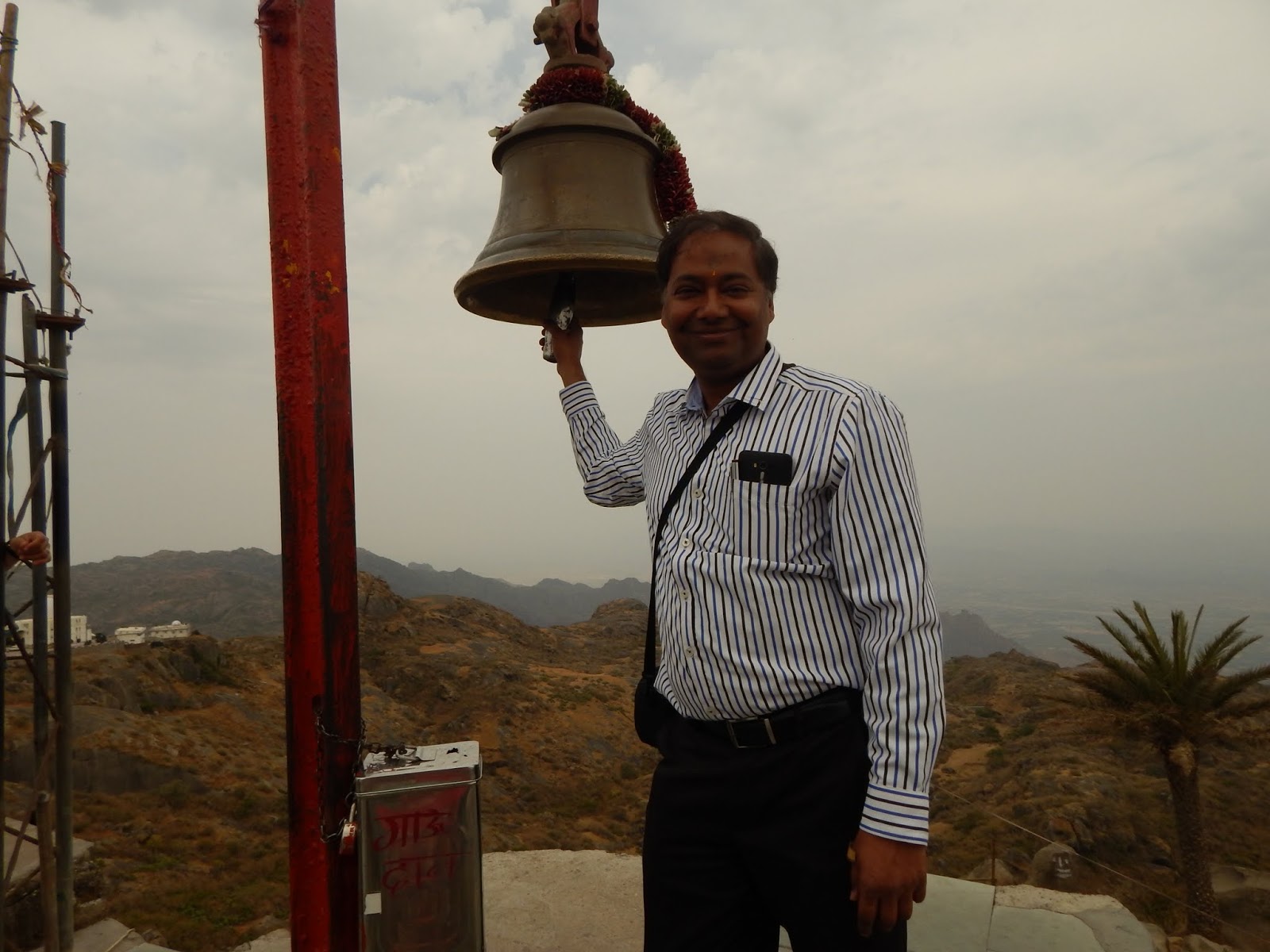
Our visit to Gurushikhar, the highest point of Aravallis also tickled my past memories.
I remember having been clicked with the large bell at the top! 
At the top: 22 years back
Notice the changed Ghanta: The metallic one, I mean!!
I have written about the peaks of various mountain ranges in India in my Pachmarhi blog.
Gurushikhar has around 300 steps to reach the top. There is a Dattatreya temple at 65 steps.

Tuesday, April 5, 2016

A trip to Mewar: land of bravery, beauty, bhakti, sacrifice & loyalty!


  It was a much needed break, at least we thought so! And we were looking forward to it. Initially we were apprehensive as our plans to go to Udaipur had fizzled out twice earlier and converted into Pachmarhi trip once. However, as time closed in, things kept on becoming smoother and omens were good!
We reached in morning and were fresh that gave us whole day for activities. From the train I could see that the city was surrounded by hills on all side. What I was seeing was Girwa valley! We reached the land of most celebrated Raputs of the country- Mewar! It has been the kings of Mewar who are considered to be the epitome of the spirit of freedom and have been the icon of hindu resistance against invading muslim rulers. The kings who led their forces from the front riding on horses against their enemies who rode on elephants with sepoys in front to fight and protect them. Paintings of battle of Haldighati at City Palace beautifully depicted this. These paintings are remarkable for various reasons. One, the magnitude with which they depict the battle, second, how they animate the sequence of events that happened and third, what looked very strange to me! The horses were shown wearing elephant like trunks.

Statue of Chetak at City Palace, Udaipur!
I wondered what kind of a deceit tactic that was! Rajputs of Mewar under Rana Pratap had developed art of Guerilla warfare that needed various tricks to outsmart the enemy. Elephants in Mughal forces used to wield swords in their trunks. May be horses with trunks were mistaken to be baby elephants by adult elephants thus preventing them from attacking the horses! But then wouldn't a white trunk have been more deceptive?? I think the nearest real world animal would be a Tapir!!
This trip added another dimension to my understanding of Rajasthan. My earlier trips had been to Jaipur and I thought that is what Rajasthan is! They glorified kings of Amer and Jaipur, the lineage of Man Singh. Then I visited Jodhpur in 2010, the region known as Marwar and Jaisalmer. Rajasthan has north-western desert region of Thar and south-eastern hilly region. Mewar lies in the hilly region. It has been ruled by Moris, Guhilots and Sisodias. It was the sisodia rulers who started using the title 'Rana' or 'Maharana'. Maharana Hamir Singh, who took the kingdom back from the governor of Allauddin Khilji was the first to use the title of Maharana.

Other notable Mewar king has been Maharana Kumbha who built the kumbhalgarh fort. The fort that is located 1100 meters above sea levels in the Aravalli Ranges and is said to have never been conquered. Its 36 km strong wall is said to be second longest in world after Great Wall of China. This fort was used as a safe haven for the Mewar rulers in times of attack. It separates Mewar from Marwar. In fact, this fort is associated with the story of Panna Dhai, the lady who is considered to be sacrifice personified. After killing son of Rana Sanga, Banvir Singh wanted to kill his younger son Udai Singh II to usurp the throne. However, Panna Dhai, in order to protect the young prince, just in the nick of time, got Udai singh smuggled out of the palace and placed her own son in his place whom Banvir Singh brutally murdered. Later Panna Dhai took Udai singh to the safe Kumbhalgrah and after few years helped Udai Singh II regain his throne by helping him establish the identity and disappeared for ever. 
Banvir Singh killing son of Panna Dhai in place of Udai Singh
Kumbhalgarh has become the place of resorts now for people who want to spend vacation time. The light and sound show is said to be the best but to see that one must stay around Kumbhalgarh as it becomes unsafe to travel after dark. It takes around 3 hrs to reach Udaipur by car. I wonder how much time it took for Udai Singh II to reach and establish the new capital of Mewar from Kumbhalgarh to Udaipur after Chittor was taken.
The traditional capital of Mewar was Chittor and the fort known as Chittorgarh fort. It is around 120 kms from Udaipur. We could not visit it as it needed another day in in the itinerary, however we learnt about it from the Haldighati museum and city palace in Udaipur.
It is not known that who built the chittorgarh fort. Bappa Rawal, the founder of Mewar kingdom, is said to have established it as his capital in 8th century AD . Chittorgarh represents the glory of Mewar. It was here that rani padmini committed Jauhar after it was seiged by Allauddin khilji. Jauhar again happened in this fort twice, by Rani Karnawati et al on being captured by Ahmed Shah of Gujarat and again on being seiged by Akbar. Rana Pratap reclaimed all of the Mewar from Akbar except Chittorgarh fort and died with this unfulfilled wish. Chittor has represented the heroism of Mewar whether it was Rana Sanga fighting Babur or Rana Pratap fighting Akbar. The romanticism of Chittor is added by being associated with Meera. She is believed to have been married here and resisted all the brutality after the death of her husband due to her bhakti for Lord Krishna. 
Thinking that so many of the most glorious stories of Indian history and culture emanate from this small region of the country, Rani padmini, Meera Bai, Panna Dhai, Rana Pratap.....makes me wonder!!
Udaipur was made capital as Chittor remained under seige, by Udai singh II and continued to rise in prominence. Artifical lakes, huge in size were created; Pichola, Fateh Sagar, Raj Samand...... over time so much so that it became a city of lakes in the desert state of Rajasthan, but as I have mentioned earlier, it is the hilly area rather the core desert area of the state. Elaborate Palaces and Havellis occupy the land around and in the lakes and then beautiful gardens were developed. Lakes, palaces and garden make udaipur serene, grand and beautiful. What pleases the eye is that it is relatively clean. Udai Vilas, palace converted into hotel is said to be one of the most expensive and plush hotels of India.
Boat ride in lake Pichola at Sunset is the highlight of Udaipur trip as one's eyes savour the beautiful palaces all around which light up as the sun sets. We visited it when moon was also in it's full bloom. Very pleasing experience it was!!


Before moving on I would like to mention about horses of Mewar. Mewar developed their own breed known as Mewari. They are known for their in-turned ears that are capable of turning 180 degrees. Ranas used their horses against Mughal elephants. These horses lost their sheen during british times due to neglect and breeding of imported horses. 'Chetak' a legendary horse from Mewar epitomizing loyalty was, however, a kathiawari breed! Whatever breed it was, it has etched a golden letter history for horses for all-time.
Udaipur is one capital that has been totally developed by its rulers. It might have been like any other hilly area of the region prior to that and not endowed with much natural beauty otherwise. 'Saheliyon ki Bari' is one great example. The Ranas had already developed the huge Fateh Sagar Lake. It is said that Rana Sangram Singh's wife brought 48 maidens with her in dowry. The Rana built a garden with fountains. He built a pond with where the queen with all her friends could frolic in water. Five domes with fountains coming out of birds beaks were built. There was no electricity at that time and some physics was used to create these fountains. The ponds were built at a lower altitude that fateh Sagar lake and channels were drawn from the lake to the fountains with valves placed to control the water-flow. I think it's the oldest water park I have seen. At the rear is a beautiful lotus pond surrounded by elephant statue fountains on all sides. One wonders how was the channel for fountain made through  the monoliths' trunks. On the left is a section called 'Saavan-bhadon' that gives a feel of perpetual rain. When we entered this section the breeze was unusually cool. In fact I was surprised to see so many of plants, that need perennial water,  growing there! The compound also has a 200 years old bougainvillea tree. It's a very picturesque place and we loved relaxing and spending time here. Easily the best garden of the city. It gives an insight into the luxury enjoyed by erstwhile princesses when there were no waterparks!

At Saheliyon Ki Bari

City Palace Zoom in from Karni Mata Temple

Overview of City Palace

City Palace as viewed from Lake Pichola
City Palace is the emblem of the city!The exteriors reminded me of Monaco. They were that clean!One goes through the palace looking at various exhibits narrating the royal history of Mewar. One can feel that it was used for residence till lately. There is a courtyard that is rented out for lavish functions. It has a very different feel compared to the City Palace of Jaipur. One feels it is real, something contemporary that has it's history.

Continued......
In our hospital there are many trees, wide in variety, in fact a treat for a plant enthusiast! And I now of at least one plant enthusiast in our hospital.He introduced me to some of the amazing plants in our campus. In fact, he has created a small nursery in the campus out of his own efforts. 
There is one type of tree that has fascinated me ever since I joined here. These are big trees, that shed their leaves completely by the winter end, that is not even a single leaf is found on them at that time, but the whole tree bears only red coloured flowers and then these fleshy flowers keep on falling till spring arrives and once they shed all flowers, new leaves arrive. It looks like a totally different tree. The flowers that fall initially are quite fleshy and so messy. It's a bane to park your car under this tree from Jan to March. Whenever I saw crushed flowers, I always wondered whether these can be used for making natural colours, or for food. I came to know that this tree is called 'Semal' or 'Shalmali' ( making me understand from where did the singer 'Shalmali Kholgade' got her name) (Can't help it but have fixation for origin of names!!) It's botanical name is Bombax ceiba. In fact it's fruit is used to make cotton and certain edible things like pickle. It is said to have medicinal value for hemoptysis. I wonder whether I can collect the thousands of flowers that fall in my hospital to make some remedy for hemoptysis - an indigenous solution!! I tend to generalize things and thought that "Oh! so it belongs to cotton family!" but when I checked, I found cotton is Gossypium, oh ya ya, I could recollect!
A Semal tree in bloom in Delhi

On our way from Udaipur to Mount Abu and also on our way to Haldighati I saw trees that looked like Semal. They had only flowers with no leaves. These flowers were the colour of flame and more beautiful than Semal flowers. At places, where there were many trees in the forest, it looked as if there were flames in the forest. I asked my driver, "which tree is that?" He said, "That is Palash" "Oh Palash, my eyes widened!" I asked him to park the car so that I could have a closer look!
A Palash tree near Haldighati

A blooming Palash tree: resembles Semal

A Palash flower with the tree in backdrop!
A myriad of thoughts crossed my minds. My introduction to this flower was through the celebrated hindi poem 'Palash ke phool' or is it an Upanyas by Dr Saroj Vyas?? Though I do not know the intended reference there! I could not see Palash when I visited Plassey in Bengal. I recalled it is also called "Flame of forest",how apt!! I used to think that it is found predominantly in Bengal but I was wrong, I found it in the desert state of Rajasthan! Our driver told us that these flowers are collected and natural colours for holi are made, I thought' "Obviously I know!" Over a gap of 5 minutes I was again more knowledgeable than our driver! I told my kids, "it must be of the same family as Semal as they look so same and have so similar cycle" My confidence was growing. My kids said, "Papa, kuchh bhi!!" I tried to convince them regarding my great understanding and knowledge and inferences and .... so on! However, I failed to satisfy them, as usual!! I knew I had help. I resorted to "baba google!" My confidence got brutally 'dharashayi..ed' when I came to know that Palash is Butea monosperma belonging to a different family 'Fabacae'. While Palash tree wood is strong and used for timber, Semal wood is weak and can not be used for timber. Gum of Palash, called 'kamarkas' is used in food while the cotton from Semal is called 'Kopak'. I tried to regain my ground. Cotton and Semal both belong to Malvacae so I was right initially, some years back when I must have thought about the relation. Did I?? Must have..... . Then, both Shalmali or sumbul and Palash are common names. ( I know only one person each with the names Shalmali and Sumbul! !) Anyway! the whole thing led to such an 'izafa' in everyones botanical knowledge!! Kids were still not listening! They never do!!

We were going from Udaipur to Mount Abu on the day of Chhoti Holi. We were bit anxious, as we had heard about the notoriety on that day. We were also told that we would be crossing an area inhabited predominatly by 'Garasiya' tribe. Till then we had heard about the laurels of 'Bhils' who had helped Rana Pratap and achieved glory! The origin of Garasiya tribe is said to be in this region of 'Sirohi' of Abu region, where they live. They are rajputs. It is claimed that they descend from the Chauhan rajputs of Jalore, who were defeated by Allauddin Khilji. They probably married Bhils who were inhabitants of the area. We were told that they carry a hansiya or daranti (Sickle) like weapon which they hang on the back of their collar and attack to loot if required as they don't have means of earning. We saw the colourful dress that they wear. In fact, their Ghaghra or lehenga is made of pleats of different colours, popularly known as 'assi (80) kali ka ghaghra' meaning that is has 80 triangular strips of different colours.
A Photo of Garasiya girls on web
The Lok Kala Parishad gave us insight into tribes of Rajasthan. While we had become familiar with Bhils and Garasiyas, we knew about Meenas who are our colleagues. We also came to know about 'Gadhiya Lohars'. I had seen these people many times in my childhood. They were the 'banjaras', that I knew of. These people are blacksmiths who travel in groups in their carts, which are distinctly designed and decorated and in fact is the 'gadi' that gives them their name.
The 'Gadi' of Gadiya Lohars
We have seen them live by the roadside for years. They sell all kinds of iron tools. They are said to be rajput descendants of Maharana Pratap's Army.
Another nomadic rajput tribe is Sansi, usually people from civilized world take their name associated with crime.
Another tribe is Kanjar, again a term used as a derogatory remark especially in Punjab. Other tribes are Sahariyas and kathodi.
Mount Abu was almost a different trip!

Tuesday, February 23, 2016

Aging

on a different note:

I happened to run into one of my senior colleagues recently. We met each other after pretty long. He was the one in whose unit I joined my job and stayed with him for 4 years. He had constantly encouraged me and was a big support that lead to honing of my skills and confidence. A feeling of warmth evokes every time I meet him, though it is becoming decreasingly probable with time.
He made a comment, "You seem to have grown up quiet a bit, you have managed to get your hair grayed, and sparse. Howsoever you may grow, but you shall remain younger to me. Is there a lot of stress?" he asked.
His comment made me ponder. I also have been thinking that stress or unhealthy lifestyle should be the cause of my rapid aging.
Same day, in the evening, I met one of my neighbours. He is my namesake and same age. I know him since childhood. He was an unruly child who used to pass with difficulty. I don't know whether he did his graduation, however, he joined his family business. For last 20 years he can often be seen roaming around drunk, talking in loud and abusive language to his wife or other people. He commonly spits a mouthful from the first floor on which he lives on to the road. The point where he plops the rusty  spit everyday after chewing tobacco and beetle leaf has become saffron indicating its suffering and martyrdom. Sometimes, he is seen relieving himself in park adjoining his house, though it is estimated that he may be having one of the best bathrooms in locality. I many a times hear him abusing somebody on phone for not making payments.
When I met him that day, it was different. I noticed his hair, they are thick and black! May be they are coloured, but they are not weaved definitely. He looks the same, that he used to 10 years ago.
I wondered, does this guy have less stress than I have? Is his body healthier than me??

Friday, December 4, 2015

Our generation

Our generation


With me a generation was born
That would grow with me
And all others- elder or younger,
Would it critically see!
And this generation was
‘Giant robot, Different Strokes’ generation
Black and white TVs
Larger than life dreams
Good to be a perfectionist
Right was right and
Wrong was wrong
Because that is what
Was right or was wrong!

Then came coloured Tvs,
Beautiful sets of Yash Chopra Movies
Good looking was right
And ugly was wrong
And the western influence increased
Rock became heavy metal
Disco into beach dance
For ‘MTV generation’
Novel was right and
Conventional wrong!

Technology advanced further
FM became available
‘computer generation’ set in
Fast was right and slow wrong
And then mobile phone,
The harbinger of technology revolution,
Mobile became answer
To all that was needed
And the mobile generation
Changed to hands free
And handsfree to ‘SMS generation’
SMS – the nemesis
Nothing is right and nothing wrong
Objectivity increased,
Acceptability increased,
What you like is right
What you don’t wrong
Fine to be gay
And gay to be fine
Wives can be swapped
And your husband
Is equally mine!
Then came social media
Whatsapp, twitter and facebook,
The age of global connection,
People spend more time
Connected to their childhood friend
Across seven seas
Than their family
Across the dining table!

Times come and times go
They are better and worse
Than all other times
But ‘our generation’
The one where we spent
Our childhood

Remains the best for us!

My wife – An incomplete ode!

My wife – An incomplete ode!

I and my wife have a strange relationship, like that of any other married couple! Both of us have one leg tied to each other so we have to walk the same path. When one person wants to run out of this path, the other doesn’t let him or her do it. If one wants to stop or run fast, the other doesn’t let it happen. We end up walking the same path steadily, and although we have not reached where we think we could have but when we look back, we do seem to have covered some distance.
My wife has never been interested in symbolic gossip. She doesn’t converse in similes. She doesn’t take indirect taunts well and she criticizes directly. She does not talk of her dreams; she talks of what’s possible today. She believes in talking only about things we can make effort to happen. She does not believe in enumerating one’s own negative qualities or deeds, she does not crib over spilt milk. She does not talk about goals that could not be achieved. She does not even take blame for them and glorify them. I do all that!’
She is a mentally hard working person. She plans hard to achieve what she wants. She considers that most of the things can be done until unless proved otherwise. She puts in all the effort to make it happen. She can use and mobilize her few resources to achieve what she thinks she should. She does not believe in keeping her resources reserve till they become redundant. Failure does not affect her for long.
Mostly, what she lacks is confidence. She is easily scared but is ready to fight with all the fear. She does not have that much faith in God that I have and that is why she likes to take the responsibility of doing things herself. She is stubborn but that is where her strength to pursue comes from.
She is edgy about people’s opinion but likes to go her own way.

I am yet to understand her more!

Wednesday, November 25, 2015

शुक्रिया ऐ दोस्त!

शुक्रिया ऐ दोस्त!


आज मेरी महफ़िल में तुम भी थे
फिर उमड़ आये वो दिन बीते!

आज जब मैं ग़ज़ल पड़ रहा था
तो तुम्हारे माथे की शिकन में
तुम्हारी भावनाएं भी पड़ रहा था!

तुम उनके साथ आये
जैसे एक जिस्म दो साये,
तुमने उन्हें देख मुझे देखा
और फिर उन्हें देखा
मानो मेरा तआरुफ़ उनसे करवाया!
और फिर तुम्हारी हलकी सी हँसी
मानो पूछ रही थी
"हैँ न तुमसे हसीं ?"
फिर खो गयी तुम्हारी मुस्कान कहीं,
पूछती "क्या थी मुझमें कमी?"

तुम्हें मेरे शेर पसंद थे
पर मुझे भी अपने शेर ही अज़ीज़ थे
क्या मुशायरों में मिली दाद
से तुम्हारा पेट भरता?
क्या रोज़ वही सफ़ेद कुर्ता -पायजामा
तुम्हारी ज़िन्दगी को बेरंग न करता?
न सोचते क्या सिला मिला मेरी यारी का?
इंतज़ार कभी महफ़िलों के ख़त्म होने का
कभी उनकी तैयारी का!
क्या तुम रोज़ मेरा इंतज़ार कर
ऊब न जाते?
क्या तुम मायूसी के समन्दर
में डूब न जाते?


वो लोगों से मिलना
तोहफे देना, उपहार पाना
वो गाड़ियों में घूमना
वो सपनों को चूमना
वो गहनों की चमक
तुम्हारे बदन पर
उनकी सितारों सी झलक
वो तुम्हारा श्रृंगार करना
गर कोई उसे निहारने को न होता ?
क्या तुम सिर्फ मेरे अशआरों से मिले
उस क्षणिक आनंद
को ज़िन्दगी भर चबा पाते
या ग़म का सागर बन
मेरे फ़न को उसमें डुबोते?

आज तुम इतरा रहे थे
मुझे तालियाँ मिलने पर
उनकी बाँहों में समा रहे थे
पर मैं भी मन ही मन
मुस्कुरा रहा था
चाहे कोई कोशिश कर
मुझे चिढ़ा रहा था
पर एक बात और है
बताने को तुम्हें,
तुम जिसे मेरा रकीब
समझ रहे हो
उसका मुझ पर क़र्ज़ है
जो निभाना था मुझे
निभाया उसने वो फ़र्ज़ है,
दिए उसने तुम्हें वो लुत्फ़ सारे
जिनके लिए थे तुम मेरे आसरे
और मेरी वो आख़री ग़ज़ल
"खुद ने हम दोनों को
तुम्हें बख़्शा है..... "
उन्हीं की नज़र थी,
जिस तरह तुम्हें फक्र है
उनका होकर
मुझे भी नाज़ है उनके होने पर
ज्यों तुम्हारी हँसी का ज़िम्मा है उन पर
मेरा सुख भी उनका शुक्रगुज़ार है !


Sajeev ant!

सजीव अंत - चले जाने के बाद भी ! सीमित है समय जितनी चलनी है जीवन लय पर याद रहूँ मैं सदा जाने के बाद भी,  इसीलिए कुछ करना चाहता हूँ जीते हु...